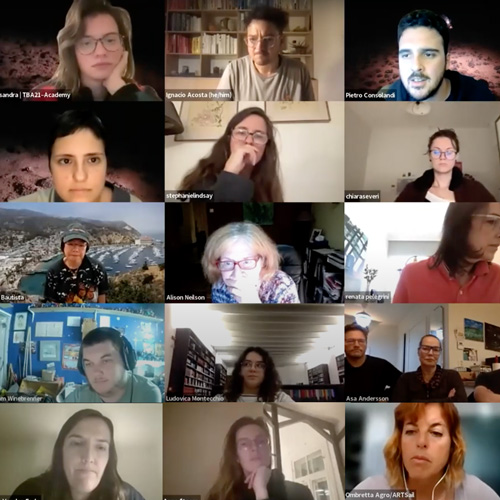
Online discussion
Washing the Sea in Green and Blue: Mineral solutions for energy transition?
TBA21–Academy, Ocean Space
Speakers: Ignacio Acosta, Sarah Vanden Eede
Wednesday, November 8, 2023, 6pm CET
—
OCEAN / UNI is an initiative dedicated to art, activism, and science that invites fluid thinking with the Ocean as a way to move beyond the binaries of land and sea. Its curriculum provides students, researchers, and the public access to wide-ranging ideas and explorations through regular live sessions, reading groups, small-scale workshops or activations, and other online material, free and accessible to everyone on Ocean-Archive.org. Aiming to complement and enhance land-based understanding of the Earth, it covers a wide range of ecological, political, aesthetic, ethical, and scientific topics around the realities and futures of the Ocean.
Between October and December 2023, OCEAN / UNI will dive towards the deep sea, adopting a cross-disciplinary lens to think from the furthest spaces of our planet’s expansive bodies of water.
By interrogating the idea of the deep sea as a commons and a space of shared value, easily translatable to economic wealth and benefits, the Fall semester works to re-state the deep sea as a living reality saturated with meaning and foundational to life itself: as a metaphor for the unknown, a place where exciting creatures flourish and meaning sprouts. This new exploration and mining frontier is a horizontal one, thousands of meters below the sea surface, and portrayed by extractivists as a “potato field” or “underwater desert”, ready to be harvested for the common good. Yet, the deep ocean and the seabed are rich with diverse and unknown life, thriving around vents, ridges, plains, and seamounts.
Framing the fight against this renewed extractivist assault upon one of the four global commons from an interdisciplinary, culture-led viewpoint, we want to assemble a diverse front that takes an affective, community-led approach to care and custodianship of the deep seas. Cultural relations with the deep seabed make it so much more than a “common heritage of mankind” to be partitioned and extracted from to provide short-term profit for a small number of humans. What would it take to maintain a thriving deep sea and seabed, and ultimately a future in which the Earth remains a liveable planet for allkind?
Through a series of five live online lectures and interactive “activations” held with diverse speakers—from scientists to artists, from lawyers and policymakers to activists and Indigenous leaders—Culturing the Deep Sea: Towards a common heritage for allkind aims to think around the constructions and representations that shape human–ocean relations, and look to art and critical thinking to raise alternatives. Through collective unlearning as a radical act of deep ocean literacy, we hope to empower ourselves as a community to intervene in dynamic decision-making environments around deep-sea mining that proceed alongside the program.
—
—