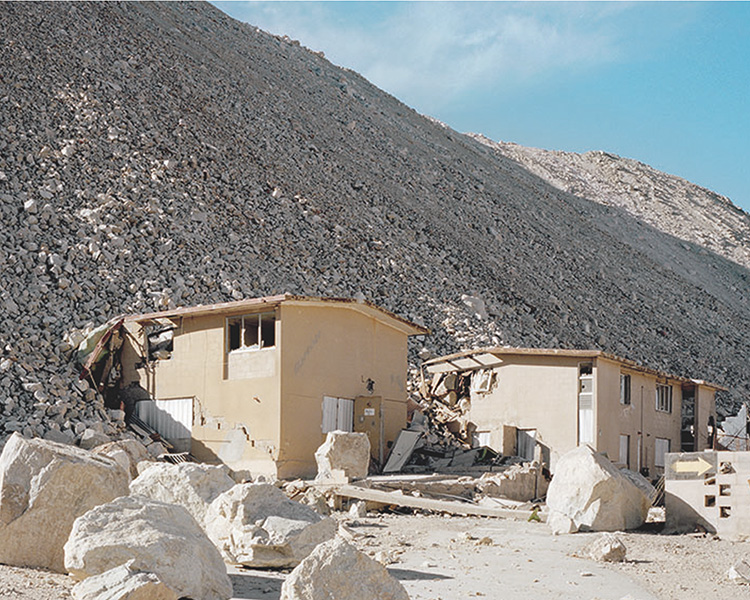
Miss Chuquicamata, The Slag
2012
The corporate town of Chuquicamata, which has the same name as the mine, was designed in the New York offices of the Guggenheims in the early decades of the twentieth century as a model town. More than thirty architects were hired to work out its urban plan. The town was established next to the mine, following the pattern of mining settlements in the U.S. such as Butte, Bisbee and Tyrone.
Due to the capitalist nature of mining endeavours, corporate towns are designed ‘to fulfil basic social necessities by maximising profits’. Functionality and profitability were the driving forces behind the growth of corporate towns. While substantially reducing costs by increasing efficiency, the typological standardisation and mass production of modular mining towns also reflects the mechanisation of the mining industry. The production of copper at Chuquicamata increased over time and it grew to become the world’s biggest open-cast copper mine. The town was evacuated in 2007. High levels of pollution, caused by the relentless expansion of the mine, threatened public health. At the time of closure, the 25,000 workers were relocated to the nearby city of Calama where new neighbourhoods were built, following the same corporate strategies of social segmentation and urban fragmentation.
Exhibitions
From Mars to Venus La Panera, Lleida, 2024-25
Paisaje | Experiencia | Producción: Fotografía y Territorios Productivos en Chile (2000-2020)Universidad de Chile,, 2023
Trafficking the Earth. Museo de Arte Contemporáneo Universidad de Chile, Santiago, 2017
–
Collection
Engel Foundation, Chile